
BRAND STRATEGY
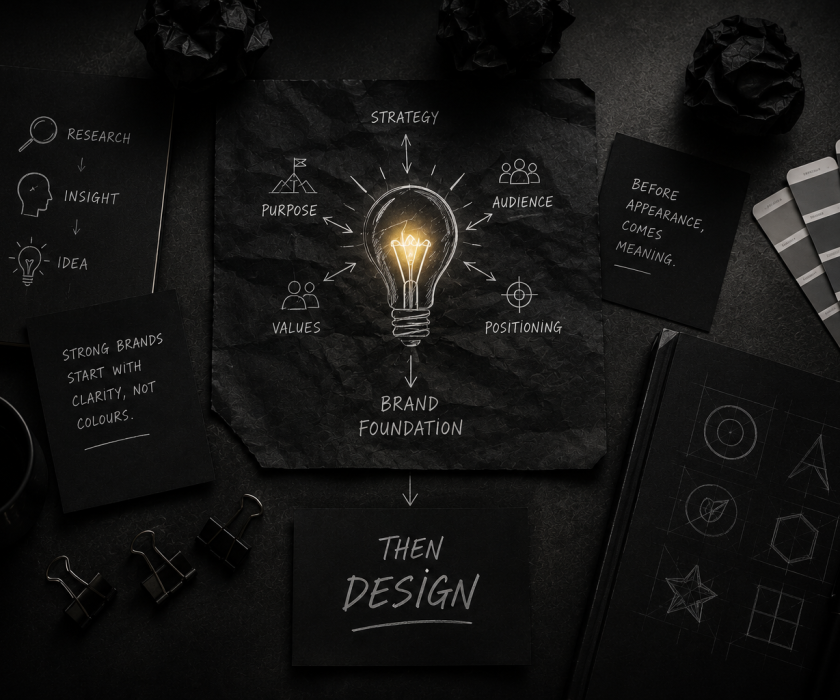
Before you decide what your brand should look like, you need to decide what you want it to mean—and where you want it to stand in the customer’s mind.
Imagine a business owner approaching a designer and saying:
“We need a new logo.”
The designer asks:
“What kind of logo are you looking for?”
The answer is often something like:
“Something modern. Premium. Unique. Maybe minimal.”
And that’s where the problem begins.
Not because those are bad design directions.
But because none of them explain what the brand is supposed to stand for.
A logo can be modern.
It can be premium.
It can be minimal.
It can even be beautifully designed.
But if the business doesn’t have a clear position in the market, the logo is being asked to solve a problem it cannot solve.
Before a brand needs a logo, it needs a reason to be remembered.
That reason comes from positioning.
What Is Brand Positioning?
Brand positioning is the strategic decision about how you want your brand to be understood and remembered relative to the alternatives available to your customer.
In simpler terms:
Positioning answers the question: “Why should someone choose us instead of someone else?”
It isn’t simply about what your company sells.
Two businesses can sell the same product and occupy completely different positions.
Two restaurants may both sell coffee.
One might position itself around:
Speciality coffee + craftsmanship + expertise
Another might position itself around:
Community + affordability + everyday convenience
The product category is similar.
The perception is completely different.
And that difference influences everything that follows—including the logo.
Positioning Is Not a Tagline
This is one of the biggest misconceptions about brand positioning.
A tagline is communication.
Positioning is strategy.
For example:
“Think Different.”
is a famous piece of brand communication.
But the strategic positioning behind a brand can be much deeper than a tagline.
Positioning involves decisions about:
- Who you want to serve
- What category or space you want to compete in
- What makes you different
- What value you want to own
- What you want to be known for
- What alternatives you are competing against
- Why your difference should matter to the customer
The tagline communicates.
Positioning determines what you’re communicating in the first place.
Why Businesses Start With the Logo
If positioning is so important, why do so many businesses begin with the logo?
Because a logo is tangible.
You can see it.
You can discuss it.
You can compare three options.
You can put it on a visiting card.
You can upload it to Instagram.
Strategy doesn’t work that way.
Strategy involves:
Research.
Questions.
Choices.
Trade-offs.
Analysis.
And sometimes uncomfortable conversations about what the business actually is—and what it cannot be.
A logo feels like progress.
Positioning creates direction.
That’s why businesses often gravitate toward design first.
But visible progress isn’t always strategic progress.
A Logo Cannot Decide What Your Brand Should Stand For
Imagine two fictional consulting companies.
Both work with growing businesses.
Both have experienced teams.
Both offer strategy and advisory services.
Company A wants to be known for:
Deep expertise, precision and high-level strategic thinking.
Company B wants to be known for:
Approachability, accessibility and practical business support.
Should their identities look identical?
Probably not.
Company A might benefit from a more authoritative and refined visual language.
Company B might need something more approachable and human.
The design decisions are different because the strategic positions are different.
Now imagine neither company has defined its position.
The designer is simply told:
“Make it look premium.”
Premium in what way?
Premium compared to whom?
Premium for which audience?
Premium because of price?
Premium because of expertise?
Premium because of experience?
Without positioning, the designer is left guessing.
Positioning Gives Design Something to Solve
This is where positioning becomes extremely valuable to designers.
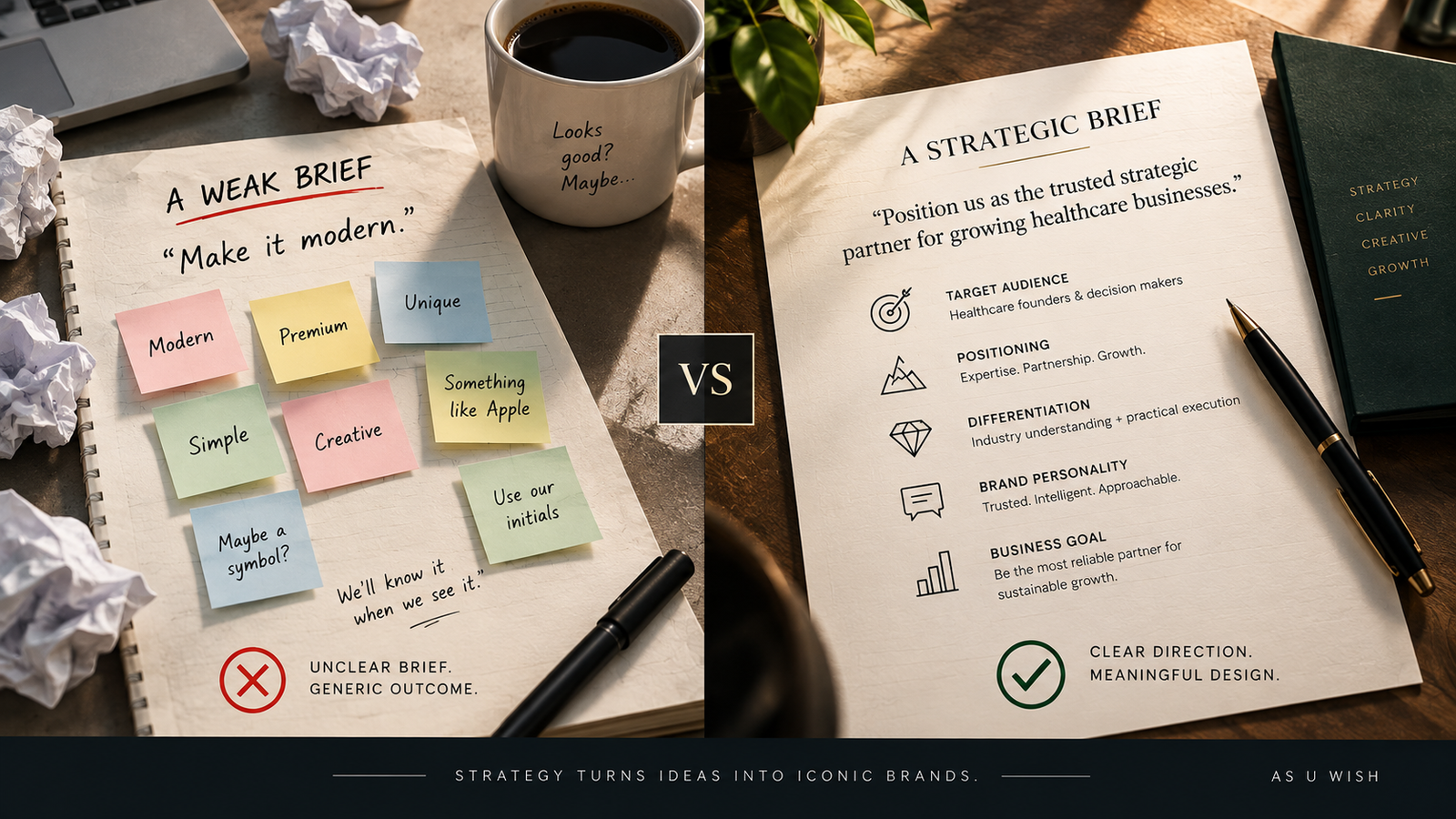
A weak brief says:
“Create a modern logo for our company.”
A stronger brief says:
“We want to become the most trusted strategic partner for growing healthcare businesses, positioned between traditional consultants and large corporate firms.”
Now the creative problem becomes much more interesting.
The designer can start asking:
- What does trust look like in this category?
- What visual codes do competitors use?
- Which ones should we adopt?
- Which ones should we avoid?
- How can we communicate expertise without appearing intimidating?
- How can we feel established without looking old-fashioned?
- How can the identity make our positioning easier to recognise?
Now design has a strategic job.
Positioning Starts With the Customer, Not the Logo
A common mistake is defining positioning from the company’s perspective.
Businesses often say:
“We provide high-quality products.”
Almost every business believes that.
Or:
“We provide excellent service.”
Again, that’s not very distinctive.
Or:
“We are passionate about what we do.”
That’s a statement about the company—not necessarily about the customer’s reason to choose it.
Better positioning begins with the customer.
Ask:
Who are we trying to matter to?
Not everyone who could theoretically buy.
The people who matter most to the business.
What problem are they trying to solve?
The functional problem is only part of the story.
There may also be an emotional or social problem.
What alternatives are they considering?
Your real competition may not always be another company.
It could be:
- Doing nothing
- Doing it themselves
- Using a cheaper alternative
- Continuing with their current supplier
- Choosing an established category leader
What matters most when they choose?
Price?
Trust?
Convenience?
Expertise?
Status?
Speed?
Experience?
Reliability?
Specialisation?
Understanding these factors makes positioning much stronger.
Positioning Requires Choosing
This is perhaps the most difficult part.
You cannot own everything.
A brand that tries to be:
- Premium
- Affordable
- Exclusive
- Accessible
- Traditional
- Modern
- Mass-market
- Highly specialised
all at once can end up communicating very little.
Strong positioning requires choices.
If you want to be known for expertise, you may need to sacrifice some of the accessibility associated with a mass-market proposition.
If you want to compete on affordability, you may not be able to create the same exclusivity as a luxury brand.
If you want to be highly specialised, you may deliberately appeal to a narrower audience.
That’s not a weakness.
That’s positioning.
Differentiation: The Heart of Positioning
Positioning and differentiation are closely connected.
Your position answers:
Where do we want to stand?
Differentiation answers:
Why do we deserve that position?
Suppose a company says:
“We are a premium branding agency.”
That’s a position.
But why should anyone believe it?
Perhaps because:
- It specialises in complex brand transformations.
- It works only with ambitious growth-stage businesses.
- It combines strategy with creative execution.
- It has deep category expertise.
- It has developed a distinctive methodology.
Now there is something behind the claim.
A position without a meaningful difference is just a statement.
Positioning Is About Perception
This is important.
Your positioning is not simply what you say about yourself.
It’s what you want the market to understand and associate with you.
You may describe your company as:
“A full-service creative agency.”
But customers may think:
“They mostly make social media posts.”
There is a gap between intended positioning and perceived positioning.
That gap is a branding problem.
And changing the logo won’t necessarily fix it.
You may need to change:
- Your messaging
- Your service structure
- Your website
- Your case studies
- Your content
- Your customer experience
- Your visual identity
- The type of clients you pursue
Sometimes, the logo is the smallest part of the problem.
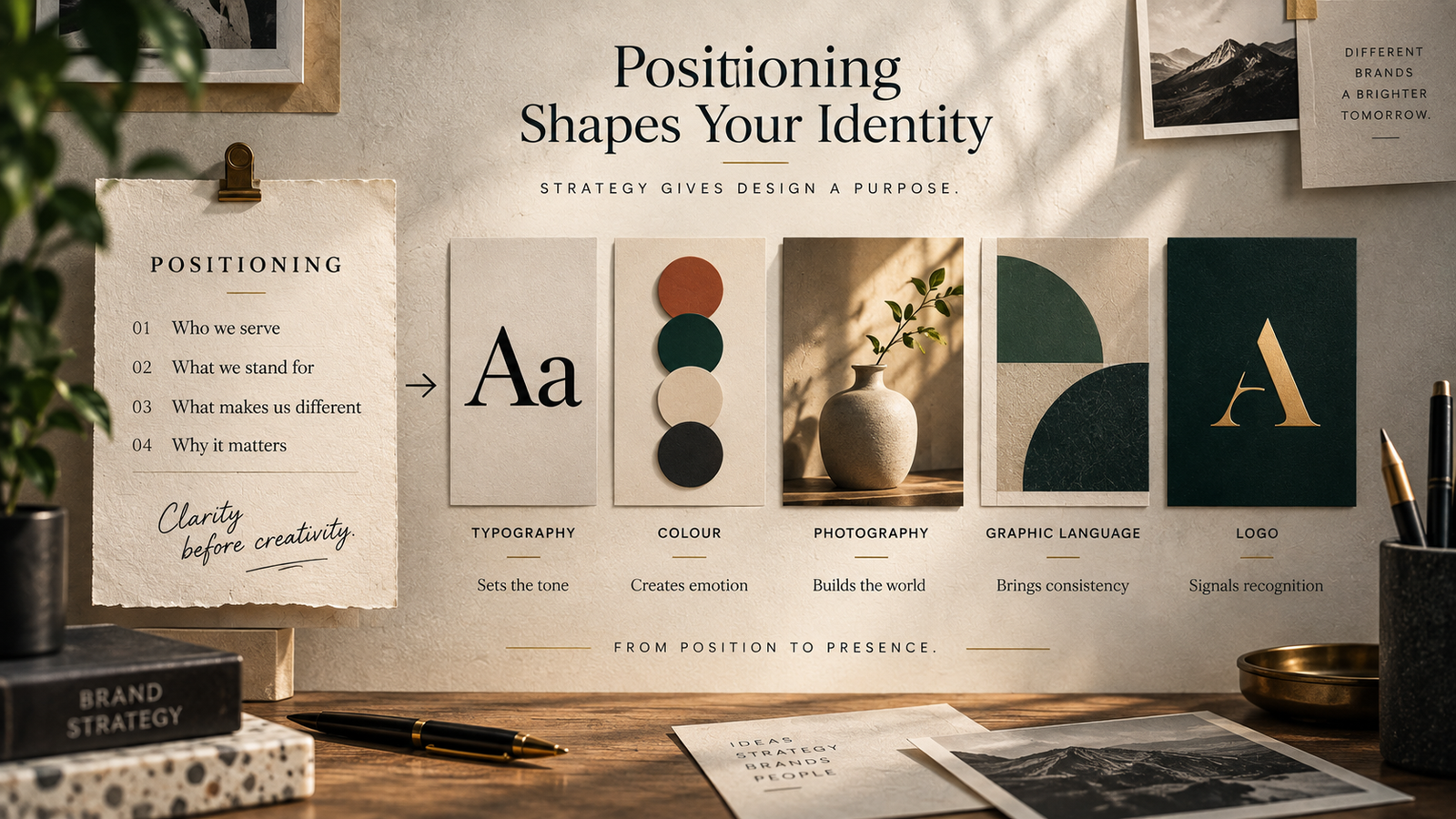
Your Positioning Should Influence Your Identity
Once your position is clear, your visual identity becomes more intentional.
Think about some of the things a brand identity communicates.
Typography
Does it feel:
- Authoritative?
- Elegant?
- Friendly?
- Technical?
- Contemporary?
- Traditional?
Colour
Does it reinforce:
- Trust?
- Energy?
- Luxury?
- Accessibility?
- Innovation?
- Calm?
Photography
Does it show:
- People?
- Products?
- Craftsmanship?
- Lifestyle?
- Technology?
- Expertise?
Graphic language
Does it feel:
- Minimal?
- Expressive?
- Structured?
- Playful?
- Editorial?
- Experimental?
None of these choices should happen in isolation.
They should support the position you want to occupy.
Consider Two Jewellery Brands
Imagine two jewellery businesses selling products at roughly the same price.
Brand A
Wants to be perceived as:
Modern jewellery for confident, fashion-conscious women.
Its identity might use:
- Contemporary typography
- Strong editorial photography
- Fashion-led compositions
- Bold but restrained colours
- A confident tone of voice
Brand B
Wants to be perceived as:
Timeless jewellery designed around meaningful personal moments.
Its identity might instead use:
- Elegant typography
- Softer photography
- More emotional storytelling
- Refined layouts
- A warmer visual language
Neither identity is automatically better.
They are designed for different positions.
And that’s exactly why positioning should come before design.
The Difference Between “What We Sell” and “Why We Are Chosen”
This distinction can transform a brand.
A company might say:
“We make handcrafted furniture.”
That’s what it sells.
But perhaps customers choose it because:
“We create timeless, handcrafted furniture for people who want their homes to feel personal rather than mass-produced.”
Now we understand something deeper.
The product is furniture.
The position is about craftsmanship, individuality and timelessness.
That difference can influence everything:
The photography.
The packaging.
The showroom.
The website.
The language.
The typography.
The logo.
The entire brand experience.
A Simple Positioning Framework
Before designing your next logo, try answering these five questions:
1. Who are we for?
Be specific.
Not:
“Everyone.”
Instead:
“Growth-stage founders who need to move from founder-led marketing to a more credible brand.”
2. What do we help them achieve?
Focus on the outcome, not just the service.
Not:
“We provide branding.”
Instead:
“We help businesses clarify what they stand for and turn it into a distinctive brand.”
3. What category do we want to compete in?
Are you:
- A design studio?
- A branding agency?
- A brand consultancy?
- A strategic creative partner?
- A specialist provider?
Your category influences customer expectations.
4. What makes us meaningfully different?
What can you credibly own that competitors cannot easily copy?
5. Why should people believe us?
What proof supports your position?
This could include:
- Experience
- Expertise
- Results
- Methodology
- Case studies
- Testimonials
- Credentials
- Specialisation
If you can answer these five questions clearly, you’re already much closer to having a useful positioning foundation.
Positioning Also Tells You What NOT to Say
This is an underrated benefit.
A clear position creates boundaries.
If your brand wants to own strategic expertise, you may not want every piece of communication to sound like:
“Get your logo designed today!”
If your brand wants to be seen as premium, constantly competing on discounts may undermine that perception.
If your brand wants to be known for specialisation, talking about every possible service may dilute the message.
Positioning therefore isn’t only about what you communicate.
It’s also about what you deliberately leave out.
The Positioning → Identity → Experience Chain
A useful way to think about the process is:
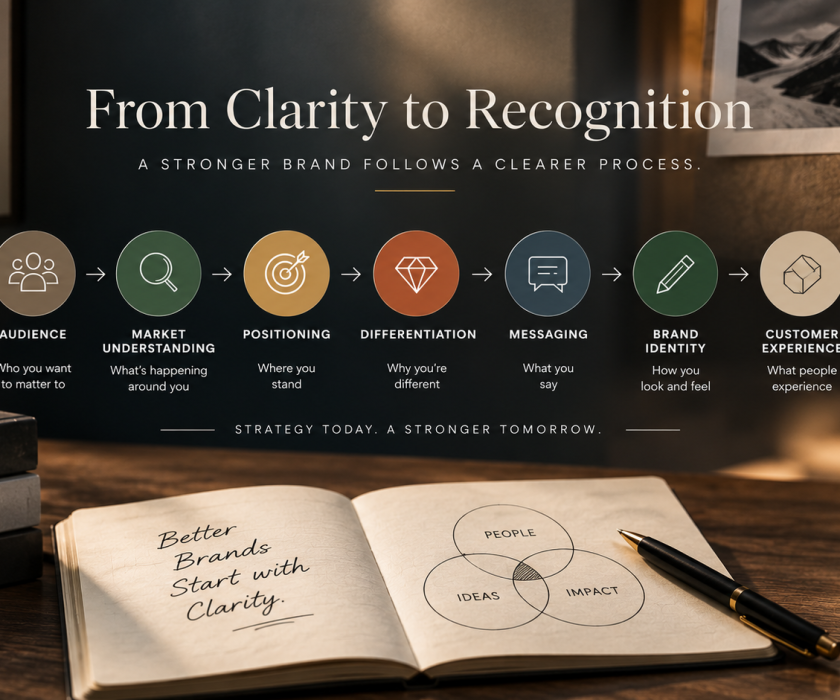
Business Objective -> Audience ->Market Understanding ->Positioning ->Differentiation ->Messaging ->Brand Identity ->Customer Experience ->Brand Perception
The logo sits somewhere in the identity layer.
It doesn’t sit at the beginning of the chain.
That’s why starting with the logo can sometimes mean starting halfway through the process.
What Happens When You Design Before Positioning?
Several things can happen.
The identity becomes generic.
It looks professional but doesn’t communicate anything distinctive.
The logo keeps changing.
Because the business keeps discovering new things it wants the identity to represent.
Everyone has a different opinion.
The founder likes one direction.
The marketing team likes another.
The designer recommends something else.
There is no strategic reference point.
The brand starts copying competitors.
Without a clear position, businesses often use competitors as their creative reference.
The result?
Everyone in the category begins to look alike.
Marketing becomes inconsistent.
Without clear positioning, every campaign starts telling a slightly different story.
And eventually, customers aren’t sure what the brand actually stands for.
The Real Cost of Designing Too Early
A logo isn’t necessarily expensive because of the design fee.
The bigger cost can come from designing without clarity.
You may later have to redesign:
- Website
- Packaging
- Signage
- Social media
- Presentations
- Sales materials
- Advertising
- Brand guidelines
The cost isn’t simply financial.
It is also the cost of confusion.
Every time you change the identity, you ask your audience to relearn you.
That’s why strategic clarity early in the process can save much more than money.
It can save brand equity.
Does Every Business Need a Formal Positioning Document?
Not necessarily.
A small business doesn’t need a 70-page branding document just to understand what makes it different.
What it does need is clarity.
At minimum, you should be able to answer:
Who are we for?
What do we want to be known for?
Why should people choose us?
What makes us different?
Why should they believe us?
If those answers are clear, they can guide everything from your logo to your website to your advertising.
The document is useful.
The thinking is essential.
So, What Should Come Before Your Logo?
Before opening Illustrator, Figma or any design software, establish:
Your audience
Who are you trying to attract?
Your category
Where do you compete?
Your positioning
What space do you want to own?
Your differentiation
Why should people choose you?
Your personality
How should the brand behave?
Your messaging
What should the brand say?
Your visual direction
How should all of that look and feel?
Then—and only then—should the logo enter the conversation.
Your Logo Should Answer a Question, Not Create One
A good logo doesn’t need to explain the entire business.
It needs to become a recognisable expression of a clearly defined brand.
When someone sees it repeatedly, the logo should eventually trigger associations:
Expertise.
Trust.
Innovation.
Craftsmanship.
Energy.
Simplicity.
Luxury.
Whatever your brand has chosen to own.
But those associations don’t come from the logo alone.
They come from repeated exposure to a consistent brand experience.
The logo becomes the signature of that experience.
The Best Logo Is Not Always the Most Beautiful Logo
This might sound controversial to designers.
But a logo doesn’t exist to win a beauty contest.
It exists to serve the brand.
A beautifully designed logo can still be wrong for the business.
A relatively simple mark can become incredibly powerful when attached to a strong position and consistently delivered experience.
The real question isn’t:
“Is this logo beautiful?”
It’s:
“Does this identity help us own the position we want?”
That’s a much better design question.
Final Thought
A business doesn’t become memorable because it has a beautiful logo.
It becomes memorable because it gives people a reason to remember it.
Positioning creates that reason.
It defines who you are trying to matter to, what you want to be known for, how you are different and why your difference deserves attention.
Only then does design have a clear job.
The logo becomes the expression of the position.
The colours reinforce the personality.
The typography establishes the tone.
The imagery builds the world around the brand.
The messaging makes the difference understandable.
And the experience makes the promise believable.
So before you ask:
“What should our logo look like?”
Ask:
“What should our brand mean?”
Because when the position is clear, the design stops being a search for something that looks good.
It becomes a search for something that means the right thing.
Want to Build a Brand With a Clear Position?
If your business is struggling to explain what makes it different—or if your visual identity looks polished but doesn’t communicate a clear market position—the problem may begin before design.
AS U WISH helps businesses clarify positioning, strategy, messaging and identity before turning those decisions into creative expression.
Explore Brand Strategy & Consulting →
Talk to AS U WISH →