

BRAND STRATEGYBRANDINGDESIGN
A brand is not a logo. It is the meaning people attach to your business. And that meaning has to be built before it can be designed.
There is a common misconception in business: when a company decides it needs branding, the first question is often, “What should our logo look like?”
Should it be modern? Minimal? Premium? Bold? Elegant?
The questions sound creative, but they are actually premature. Before a designer chooses a colour, draws a symbol or selects a typeface, a much more important question needs to be answered:
What should this brand mean to people?
That is where real branding begins.
A great brand is rarely the result of a great logo alone. It is the result of strategic decisions made long before the first design concept is presented. The logo is the visible expression of the brand.
The strategy is what gives that expression meaning.
In this article
Design Can Make a Brand Look Better. Strategy Makes It Matter.
Imagine two companies selling exactly the same product.
Both have professional websites.
Both have attractive logos.
Both use sophisticated typography.
Both have excellent social media creatives.
Yet one becomes memorable while the other remains forgettable.
Why?
Because branding is not simply about visual attractiveness.
People don’t build relationships with colours, fonts or logos. They build relationships with ideas, experiences, promises and perceptions.
A logo can tell someone what a company looks like.
A strong brand tells them:
- What the company stands for
- Who it is for
- Why it exists
- What makes it different
- What they should expect from it
- Why they should trust it
- Why they should choose it instead of another option
This is why two businesses with equally attractive identities can have completely different market positions.
Design creates recognition. Strategy creates relevance.
And relevance is what ultimately creates preference.
The Problem With Starting Branding With the Logo
One of the most common branding mistakes is starting with visual identity.
A business owner approaches an agency and says: “We need a new logo.”
The agency starts exploring symbols, colours and fonts.
After several rounds, everyone eventually chooses something they like.
But then comes the difficult question:
Why does the logo look this way?
Sometimes the answer is simply: “It looks modern.”
That is not a brand strategy.
A logo can be aesthetically pleasing and still be strategically weak. It may look premium when the brand needs to feel approachable. It may look youthful when the audience expects authority. It may look sophisticated but communicate nothing distinctive. It may even be beautifully designed but completely disconnected from the company’s actual positioning.
This happens because the designer was asked to solve a visual problem when the business actually had a strategic problem.
What Needs to Happen Before Design?
A strong branding process usually starts with questions, not sketches.
Before designing the visual identity, a business should understand several fundamental areas.
1. Brand Purpose
Why does the brand exist beyond making money?
This doesn’t mean every company needs an inspirational mission statement.
It means understanding the fundamental value the business wants to create.
For example, a healthcare brand may not simply be selling medical services.
It may be trying to make healthcare feel:
- More accessible
- More trustworthy
- More human
- More convenient
- More transparent
That underlying purpose can influence everything from messaging to visual identity.
2. Target Audience
A brand cannot be meaningful to everyone.
The question is not: “Who can buy our product?”
The better question is: “Whose problem are we specifically trying to solve?”
A premium skincare brand targeting urban working professionals should probably not communicate in exactly the same way as a mass-market personal-care brand.
A financial consultancy for large corporations should not sound like a finance app designed for college students.
The audience influences:
- Language
- Tone
- Visual style
- Brand personality
- Communication channels
- Content strategy
- Customer experience
Good branding starts by understanding people, not colours.
3. Positioning
This is one of the most important, and most misunderstood, parts of branding.
Positioning answers a simple question: Why should someone choose you instead of the alternatives?
Consider the difference between:
“We provide digital marketing services.”
and:
“We help healthcare and consumer brands turn their content into measurable growth.”
The second statement creates a much clearer territory.
It tells the audience:
- Who the company serves
- What it does
- What outcome it focuses on
That clarity can eventually influence the entire identity system.
A brand that wants to own the territory of precision and expertise may require a very different identity from one that wants to own energy and disruption.
Without positioning, design becomes decoration.
4. Brand Personality
If your brand were a person, how would it behave?
Would it be:
- Confident or humble?
- Serious or playful?
- Premium or accessible?
- Bold or understated?
- Traditional or progressive?
- Technical or conversational?
These decisions may sound abstract, but they eventually become visible.
A confident brand might use strong typography and decisive language. A sophisticated brand might use restraint, spacing and a refined visual system. A youthful brand may use more expressive layouts and conversational communication.
The important thing is that the design should express the personality, rather than inventing one randomly.
5. The Brand Promise
A brand promise is essentially the expectation you create in the customer’s mind.
It answers: “What can people consistently expect from us?”
For a luxury hotel, it might be exceptional hospitality.
For a healthcare organisation, it might be trust and personal care.
For a technology company, it might be simplicity and reliability.
For a consulting firm, it could be clarity and expertise.
The promise becomes powerful when the business can actually deliver it consistently.
Because branding isn’t only what you say. It is what you repeatedly prove.
6. Competitive Landscape
Your brand does not exist in isolation.
It exists inside a category. And every category develops visual and verbal conventions. Look at the finance, healthcare, education or technology industries and you will notice patterns.
Certain colours appear repeatedly.
Certain fonts appear repeatedly.
Certain words appear repeatedly.
Certain photography styles appear repeatedly.
Following category conventions can make a brand look credible.
But blindly following them can also make it invisible.
This creates an important strategic decision:
Which conventions should the brand follow, and which should it deliberately break?
That question cannot be answered properly without understanding the competitive landscape.
7. Brand Differentiation
Differentiation is not about being different for the sake of being different.
It is about being meaningfully different.
A business might differentiate through:
- Product
- Price
- Expertise
- Customer experience
- Distribution
- Technology
- Community
- Philosophy
- Speed
- Convenience
- Specialisation
The visual identity should then help make that difference easier to recognise.
This is where strategy and design finally meet.
The Design Is the Translation of Strategy
Once the strategic foundation is clear, design becomes much more powerful.
Now the designer isn’t asking:
“What looks good?”
The question becomes:
“What visual language best communicates what this brand wants to own in the customer’s mind?”
That changes everything.
Typography is no longer just typography. It can communicate authority, elegance, friendliness or innovation.
Colour is no longer simply a preference. It can help create recognition and differentiate the brand within its category.
Photography is no longer just about beautiful images. It can communicate the world the brand wants its customers to associate with.
Graphic elements are no longer decoration. They become part of a recognisable visual language.
And the logo? The logo becomes one component of a much larger identity system.
A Logo Is the Signature. The Brand Is the Person.
Think about your signature. It identifies you.
But your signature doesn’t explain your personality, your values, your skills or your reputation.
People understand those things through repeated interactions with you.
Brands work in much the same way.
The logo is a recognition device.
The brand is the accumulated perception created through:
- Visual identity
- Product
- Service
- Communication
- Customer experience
- Content
- People
- Reputation
- Consistency
This is why rebranding a company isn’t simply changing its logo.
Sometimes the logo needs to change. Sometimes the positioning needs to change.
Sometimes the messaging needs to change. Sometimes the customer experience needs to change.
And sometimes the company doesn’t need a new identity at all, it needs a clearer strategy.
The Brand Strategy → Identity → Experience Chain
A useful way to think about branding is as a chain:
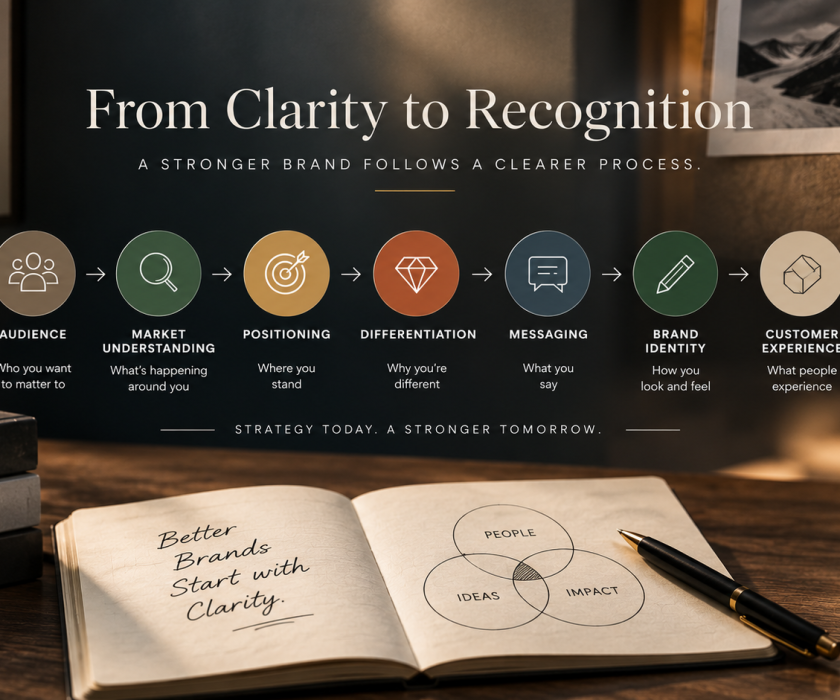
Business Strategy → Brand Strategy → Positioning → Messaging → Visual Identity → Customer Experience → Brand Perception
Every layer influences the next.
If the foundation is unclear, the identity becomes inconsistent.
If the positioning is weak, the messaging becomes generic.
If the messaging is generic, the creative becomes repetitive.
And if everything looks and sounds similar to competitors, the brand becomes difficult to remember.
This Is Why “Make It Look Premium” Isn’t a Strategy
“Make it premium.”
“Make it modern.”
“Make it luxurious.”
“Make it minimal.”
These are common design briefs.
But they aren’t complete strategic directions.
Premium for whom?
Premium compared with what?
Premium in terms of price, experience, expertise or perception?
Modern in which category?
Minimal for what purpose?
Good branding turns vague adjectives into strategic decisions.
Instead of saying:
“We want to look premium.”
You might discover:
“We want to move from a price-led perception to an expertise-led perception among senior decision-makers.”
Now the designer has something meaningful to solve.
That is the difference between designing a look and designing a brand.
What Great Branding Actually Does
Great branding should help a business achieve more than visual recognition.
It should create clarity.
It should make the company easier to understand.
It should make the difference between the company and its competitors easier to recognise.
It should create consistency across touchpoints.
It should help employees understand how the brand behaves.
And ultimately, it should make it easier for the right customers to say:
“This is for me.”
That is the real power of branding.
So, What Should You Do Before Designing a Brand?
Before opening Illustrator, Figma or Photoshop, ask:
Business
- What are we actually trying to achieve?
- Where do we want the business to go?
- What kind of customers do we want to attract?
Audience
- Who are our most valuable customers?
- What do they care about?
- What problems are they trying to solve?
- What influences their decision?
Competition
- Who are we competing with?
- What does the category currently look and sound like?
- Where are the opportunities to differentiate?
Strategy
- What do we want to be known for?
- What makes us credible?
- What makes us different?
- What should people remember about us?
Communication
- What should we say?
- How should we say it?
- What should our tone of voice feel like?
Design
- What visual territory fits the strategy?
- What should the identity communicate?
- How can the brand become recognisable without relying only on its logo?
Only after answering these questions should the creative exploration truly begin.
The Best Brands Don’t Start With “How Should We Look?”
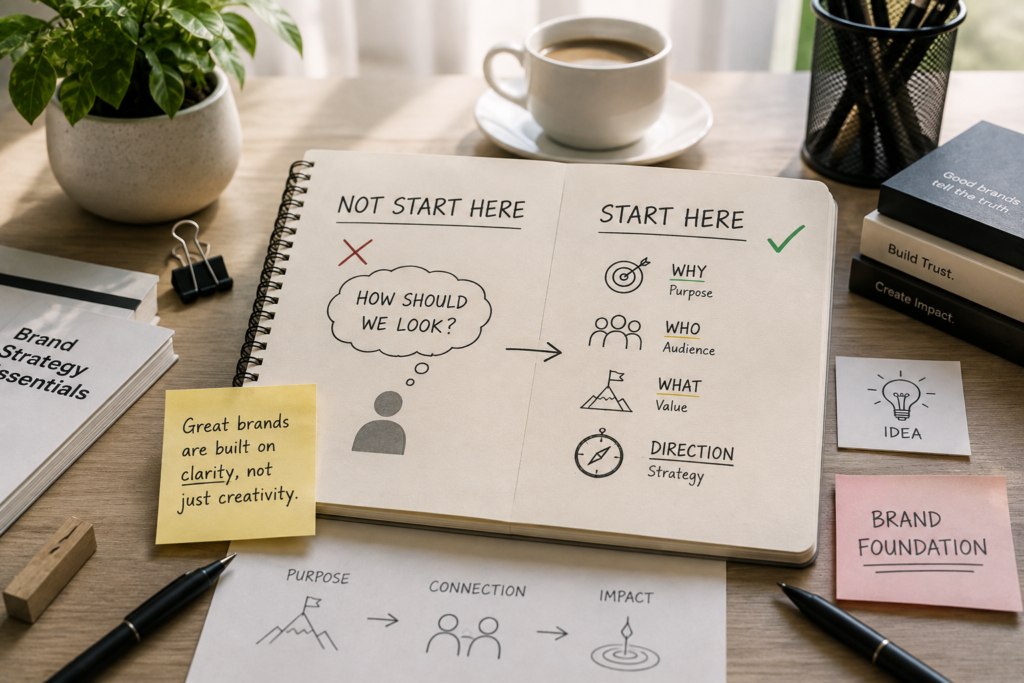
They start with:
“What should we mean?”
That single shift can completely change the branding process.
Because a brand isn’t built when the logo is approved.
A brand is built every time a customer encounters the business and forms an opinion about it.
The logo simply helps them recognise who they are encountering.
So if you’re building a new company, launching a product or considering a rebrand, don’t begin by asking your designer for three logo options.
Begin by asking:
Who are we trying to matter to?
What should we be known for?
Why should anyone choose us?
And what do we want people to remember after the interaction is over?
Once those answers are clear, design becomes much more than making something look good.
It becomes a tool for making the strategy visible.
And that is why great brands are built before they are designed.
Final Thought
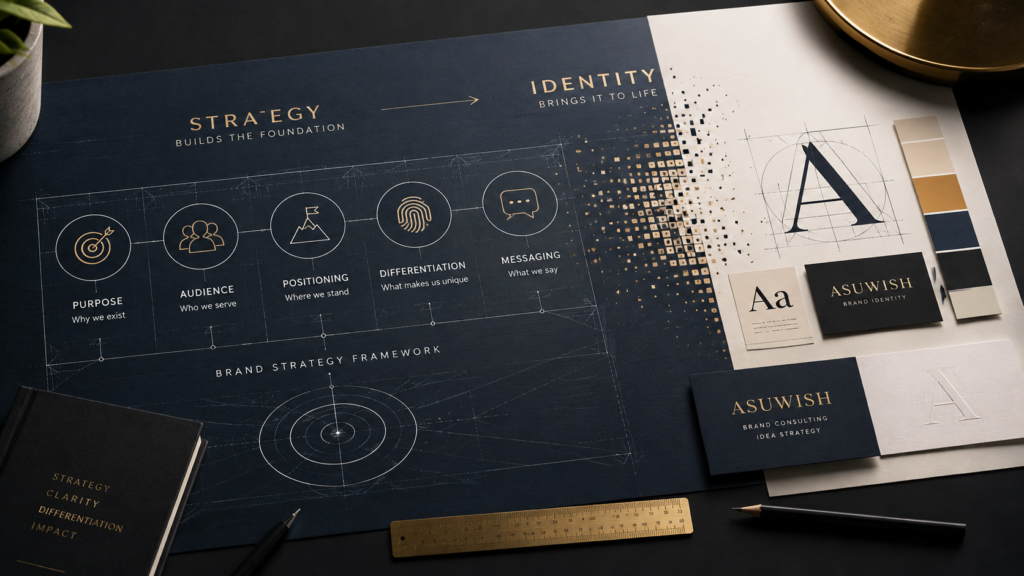
Strategy gives a brand meaning.
Design gives that meaning a visual form.
Consistency turns that form into recognition.
Experience turns recognition into trust.
That’s how brands are built.
Is your brand visually strong but strategically unclear?
AS U WISH helps businesses clarify their positioning, messaging and brand identity before turning strategy into design.
→ Explore our Brand Consulting services
→ Talk to AS U WISH about your brand
Comments(05)