

BRANDINGBRAND STRATEGY
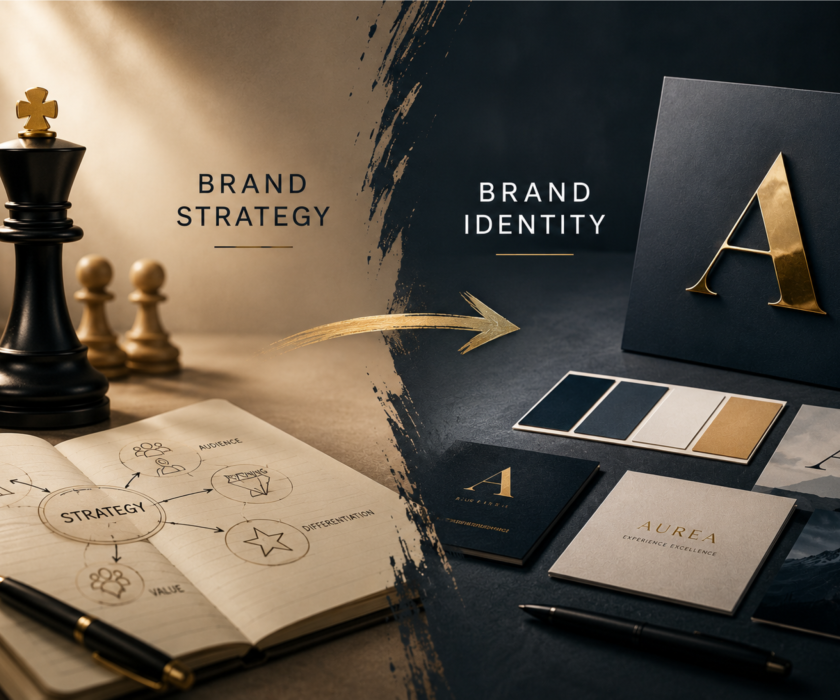
Brand strategy decides what your brand should mean.
Brand identity decides how that meaning should be expressed and recognised.
One of the most common misunderstandings in branding is treating brand strategy and brand identity as the same thing.
They aren’t.
A business may have a beautifully designed logo, a sophisticated colour palette and an impressive website, and still have no clear brand strategy.
Likewise, a company may have a strong strategic foundation but struggle to communicate it because its visual identity is inconsistent, outdated or poorly executed.
This distinction matters because branding isn’t simply about making a business look professional.
It is about creating a clear, consistent and memorable perception in the minds of the people who matter to the business.
So, what exactly is the difference between brand strategy and brand identity?
And more importantly, which one should come first?
The short answer is:
Strategy comes first. Identity follows.
But understanding why requires looking at what each actually does.
Brand Strategy vs Brand Identity at a Glance
Before going deeper, here’s the simplest way to understand the difference:
| Brand Strategy | Brand Identity |
|---|---|
| Defines what the brand stands for | Expresses what the brand stands for |
| Determines positioning | Visualises the positioning |
| Defines the target audience | Helps communicate with that audience |
| Establishes differentiation | Makes that differentiation recognisable |
| Defines personality and values | Translates personality into visual language |
| Determines what the brand should say | Helps determine how the brand should look and sound |
| Is primarily strategic | Is primarily creative |
| Answers “Why?” and “What?” | Answers “How?” |
Think of it this way:
Brand strategy is the blueprint.
Brand identity is the built structure.
You need both, but you don’t start constructing a building before deciding what you’re trying to build.
What Is Brand Strategy?
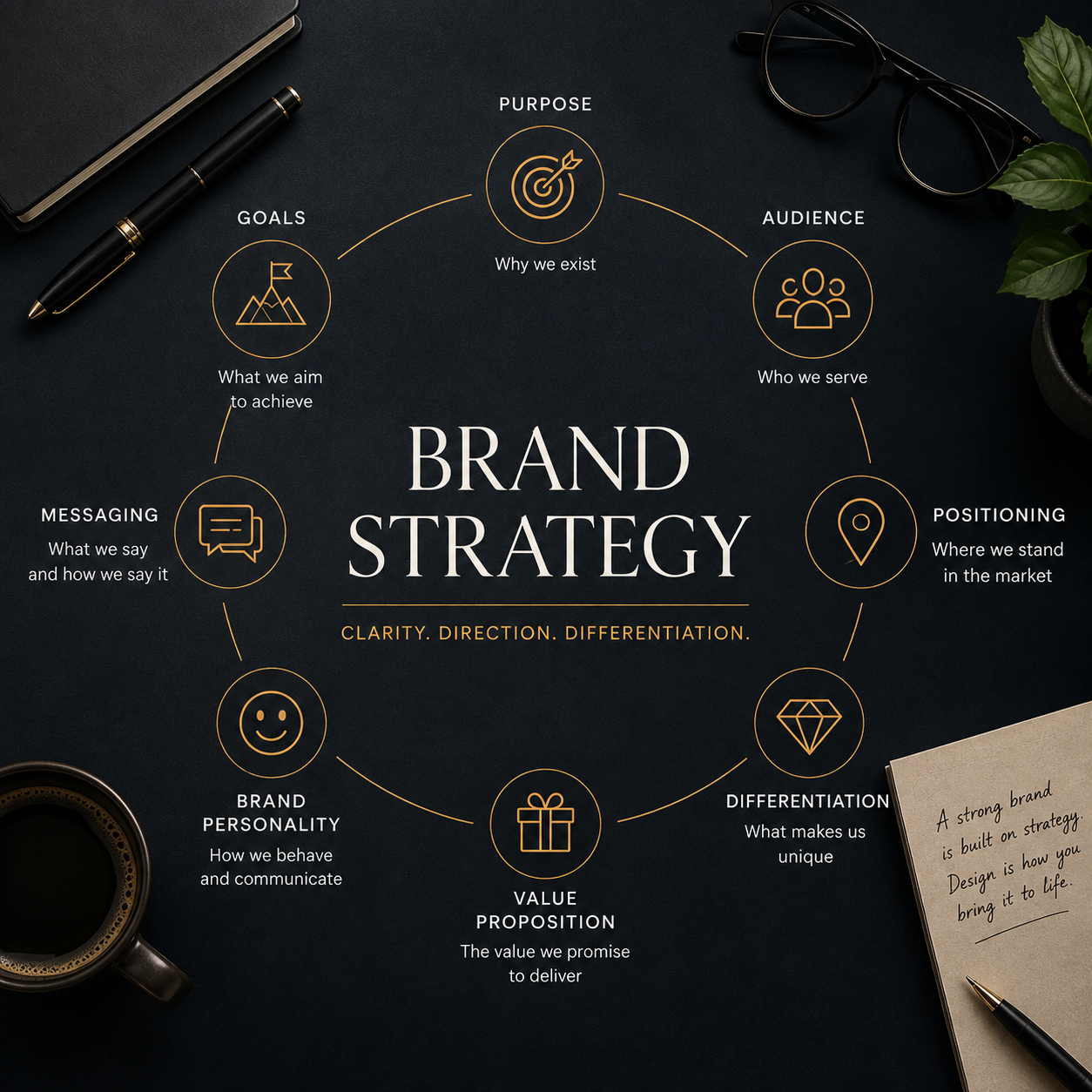
Brand strategy is the strategic framework that defines where a brand wants to sit in the market and what it wants to mean to its audience.
It connects business objectives with customer perception.
A good brand strategy answers questions such as:
- Who are we?
- Who are we trying to reach?
- What problem do we solve?
- Why should people choose us?
- What makes us different?
- What should we be known for?
- What should people believe about us?
- How should the brand behave?
- Where do we want the brand to go?
This is the thinking that happens before the visual identity is created.
For example, imagine a company that provides financial advice.
Saying:
“We are a financial consultancy.”
doesn’t tell us much about its positioning.
But imagine the strategy reveals:
“We help first-generation entrepreneurs make complex financial decisions with clarity and confidence.”
Now we have something much more useful.
The target audience is clearer.
The emotional benefit is clearer.
The personality is clearer.
The positioning is clearer.
And that information can eventually influence the identity.
The strategy gives the designer something meaningful to translate.
What Is Brand Identity?
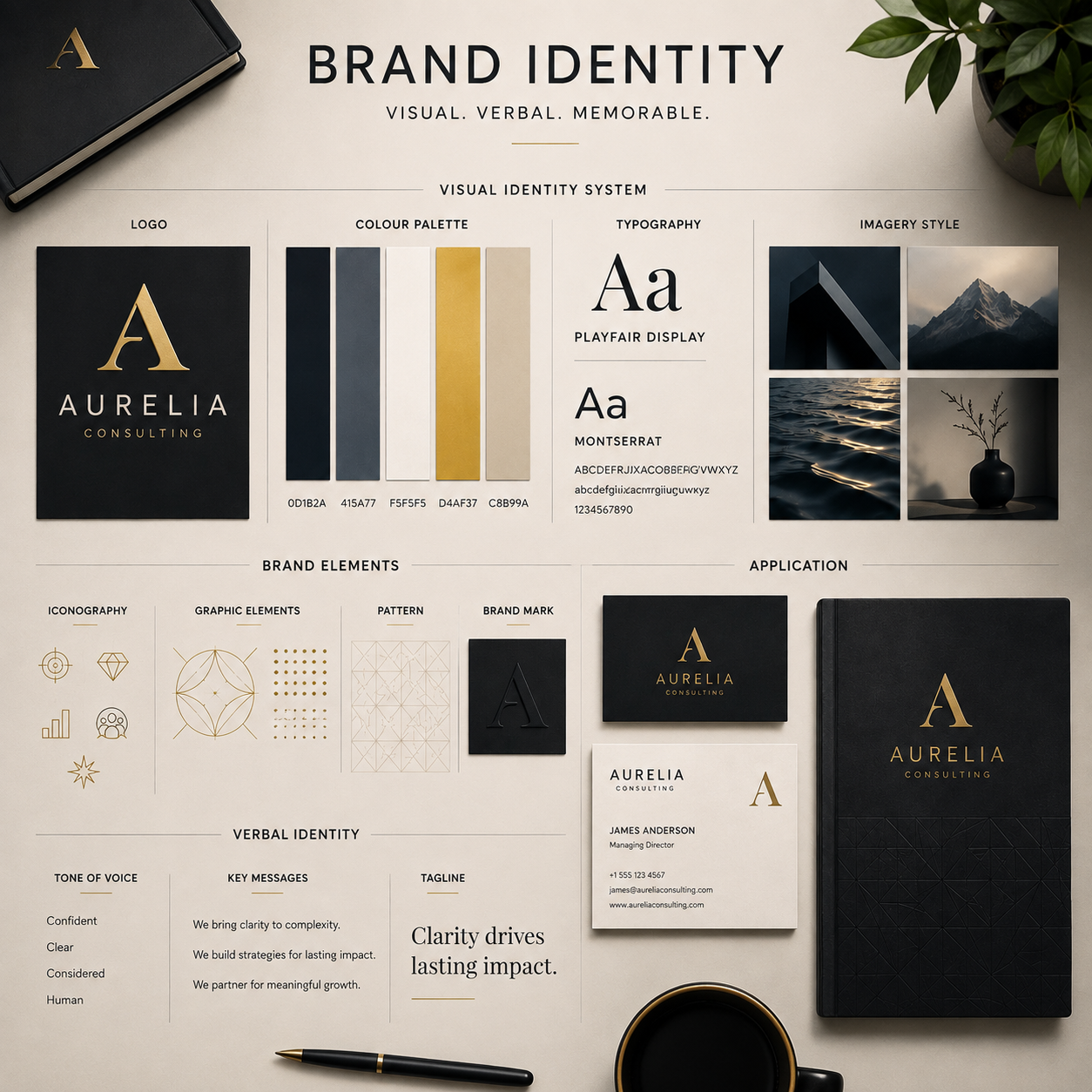
Brand identity is the collection of visual and verbal elements a business uses to express and communicate its brand.
It is how the brand presents itself to the world.
It can include:
- Logo
- Typography
- Colour palette
- Photography style
- Graphic elements
- Illustration style
- Iconography
- Layout system
- Packaging
- Brand guidelines
- Tone of voice
- Messaging principles
- Verbal identity
This is why calling a logo “the brand” is misleading.
A logo is only one component of a brand identity.
A strong identity creates a consistent visual and verbal language that allows people to recognise the brand across different touchpoints.
The website should feel like the same brand as the social media page.
The packaging should feel like the same brand as the advertisement.
The presentation should feel like the same brand as the office environment.
The identity creates that consistency.
Brand Strategy Is the Thinking. Brand Identity Is the Expression.
Here’s a simple analogy.
Imagine you’re directing a film.
Before shooting begins, you need to know:
- What is the story?
- Who are the characters?
- What is the emotional direction?
- What should the audience feel?
- What is the central message?
That’s strategy.
Then you decide:
- How should the scenes look?
- What colours should dominate?
- What should the characters wear?
- What should the lighting feel like?
- What visual language should the film use?
That’s expression.
You wouldn’t start by choosing the lighting before knowing what story you’re telling.
Branding works in much the same way.
Strategy determines the meaning.
Identity gives that meaning form.
What Does Brand Strategy Include?
Brand strategy can vary depending on the business, but several elements appear repeatedly.
1. Brand Purpose
Why does the brand exist?
Not simply:
“We sell products.”
but:
“What value are we trying to create?”
Purpose provides a larger direction for the brand.
2. Target Audience
Who is the brand really trying to matter to?
A brand cannot effectively communicate with everyone.
Understanding the audience helps determine:
- What matters to them
- What problems they have
- What influences their decisions
- What language they respond to
- What expectations they have from the category
3. Brand Positioning
Positioning defines the space you want your brand to occupy in the customer’s mind.
It answers:
Why should someone choose us instead of the alternatives?
This is where differentiation becomes important.
A business can be good at what it does without being clearly positioned.
Good positioning makes the difference easier to understand.
4. Brand Differentiation
What makes the business meaningfully different?
It could be:
- Expertise
- Experience
- Product innovation
- Service
- Convenience
- Specialisation
- Community
- Technology
- Philosophy
- Customer experience
The goal isn’t to be different simply for attention.
The goal is to have a difference that matters to the audience.
5. Brand Personality
If the brand were a person, how would it behave?
Would it be:
Confident?
Approachable?
Sophisticated?
Playful?
Authoritative?
Progressive?
Warm?
This personality eventually influences both verbal and visual expression.
6. Brand Messaging
What should the brand communicate?
This can include:
- Brand promise
- Key messages
- Value proposition
- Tone of voice
- Tagline
- Messaging hierarchy
Without clear messaging, even a beautiful identity can struggle to communicate what makes the business valuable.
What Does Brand Identity Include?
Once the strategic direction is clear, the identity can begin translating that strategy into recognisable assets.
Visual Identity
This is the part most people traditionally associate with branding.
It may include:
Logo
The primary recognition mark.
Typography
The typefaces and typographic system that help establish personality and consistency.
Colour
Colours can contribute to recognition, emotional association and differentiation.
Imagery
Photography, illustration and visual composition help establish the world the brand inhabits.
Graphic Language
Shapes, patterns, icons, textures and other supporting elements create a distinctive visual system.
Layout
How information is organised across websites, presentations, packaging, social media and other communications.
Together, these elements form a visual identity system.
Brand Identity Is Bigger Than a Logo
This is worth emphasising.
A logo is designed to identify.
A brand identity is designed to create a consistent expression.
Consider a company with:
- A great logo
- Five different fonts
- Random colours across social media
- Inconsistent photography
- Different tones of voice
- No consistent layout system
It technically has a logo.
But it doesn’t have a strong identity system.
Now imagine another company where every customer touchpoint feels connected.
The typography is consistent.
The colours are recognisable.
The imagery has a distinctive style.
The messaging sounds like the same company everywhere.
The layouts follow a recognisable system.
That’s identity doing its job.
Consistency turns individual design elements into a brand identity.
Can You Have Brand Identity Without Brand Strategy?
Absolutely.
And this is where many businesses get into trouble.
A company can hire a designer and create:
- A logo
- Business cards
- Website
- Social media templates
- Packaging
without ever answering the strategic questions behind them.
The result may look polished.
But it may not communicate anything distinctive.
You end up with a brand that looks good but doesn’t necessarily stand for something clear.
This is one reason businesses sometimes go through multiple logo redesigns without solving their real branding problem.
The problem wasn’t the logo.
The problem was the absence of strategic clarity.
Can You Have Brand Strategy Without Brand Identity?
Yes! But it creates a different problem.
A company might know:
- Who it serves
- What it stands for
- How it is positioned
- What makes it different
- What it wants to communicate
but still communicate inconsistently.
Without a strong identity, the strategy can remain invisible or fragmented.
This is why strategy and identity need each other.
Strategy without identity can remain invisible.
Identity without strategy can become meaningless decoration.
The strongest brands connect the two.
The Relationship Between Strategy and Identity
Think of the process as a chain:
Business Goals
↓
Brand Strategy
↓
Positioning
↓
Audience
↓
Personality
↓
Messaging
↓
Brand Identity
↓
Customer Experience
↓
Brand Perception
Every stage has a role.
The strategy defines the direction.
The identity makes that direction visible and recognisable.
The customer experience then reinforces—or contradicts—the promise.
And over time, these repeated interactions shape perception.
A Practical Example
Imagine two fictional coffee brands.
Brand A
Its strategy is:
Premium speciality coffee for design-conscious urban professionals who value craftsmanship and origin.
The identity might therefore explore:
- Sophisticated typography
- Restrained colour palette
- Editorial photography
- Detailed information about coffee origin
- Refined packaging
- Minimal but distinctive graphic language
Everything reinforces the strategic idea of craftsmanship and sophistication.
Brand B
Its strategy is:
An energetic community coffee brand designed to make neighbourhood coffee culture more social and accessible.
Its identity could move in a completely different direction:
- More expressive typography
- Energetic graphic elements
- More conversational language
- Community-focused imagery
- More playful packaging
Neither identity is inherently better.
They are simply expressions of different strategic positions.
That’s the point.
Good design isn’t about creating the most beautiful identity in isolation.
It’s about creating the right identity for the strategy.
Why Businesses Often Get This Backwards
There are several reasons.
1. Design is easier to see
A logo is tangible.
You can put it on a screen and immediately react to it.
Strategy is less visible.
It involves research, discussion, analysis and decisions.
2. Businesses want immediate results
A new logo feels like progress.
But changing the logo doesn’t automatically change how customers perceive the business.
3. “Make it premium” sounds easier than defining positioning
It’s much easier to say:
“Make us look premium.”
than:
“We want to move from being perceived as a commodity provider to being recognised as a specialist partner for high-value clients.”
The second statement requires strategic thinking.
4. Branding is often confused with graphic design
Graphic design can be part of branding.
But branding is broader than graphic design.
Design is one of the tools. Branding is the larger system.
So Which Comes First: Brand Strategy or Brand Identity?
Brand strategy comes first.
Not because design is less important.
Because design becomes more effective when it has something meaningful to communicate.
A useful process looks like this:
Step 1 Understand the Business
What are we trying to achieve?
Step 2 Understand the Audience
Who are we trying to influence?
Step 3 Understand the Market
What does the competitive landscape look like?
Step 4 Define Positioning
What territory should the brand own?
Step 5 Define Personality
How should the brand behave?
Step 6 Define Messaging
What should the brand say?
Step 7 Develop the Identity
How should all of this look and feel?
Step 8 Apply It Consistently
How does it appear across every customer touchpoint?
This is how strategy becomes visible.
The Difference in One Sentence
If you remember only one thing from this article, remember this:
Brand strategy defines what you want your brand to mean; brand identity defines how you express and communicate that meaning.
Or even more simply:
Strategy is the thinking.
Identity is the expression.
What Happens When Strategy and Identity Work Together?
This is where branding becomes powerful.
The audience understands what you do.
They recognise your visual language.
They understand your difference.
Your communication becomes more consistent.
Your marketing becomes easier to align.
Your team has clearer guidelines.
Your customers begin to develop expectations.
And repeated exposure creates familiarity.
Eventually, the goal isn’t simply for someone to recognise your logo.
It’s for them to recognise what the logo represents.
That’s the difference between recognition and meaning.
A Brand Is Not What You Design. It Is What People Understand.
A brand identity can be designed.
A brand strategy can be defined.
But the brand itself exists in the mind of the audience.
You can design a beautiful identity.
You can write compelling messaging.
You can define an impressive positioning statement.
But if the actual customer experience doesn’t support those promises, the perception will eventually diverge from the intention.
That’s why branding is ultimately a combination of:
Strategy + Identity + Experience + Consistency
The identity gives people something to recognise.
The strategy gives that recognition meaning.
The experience gives the promise credibility.
And consistency turns all of it into memory.
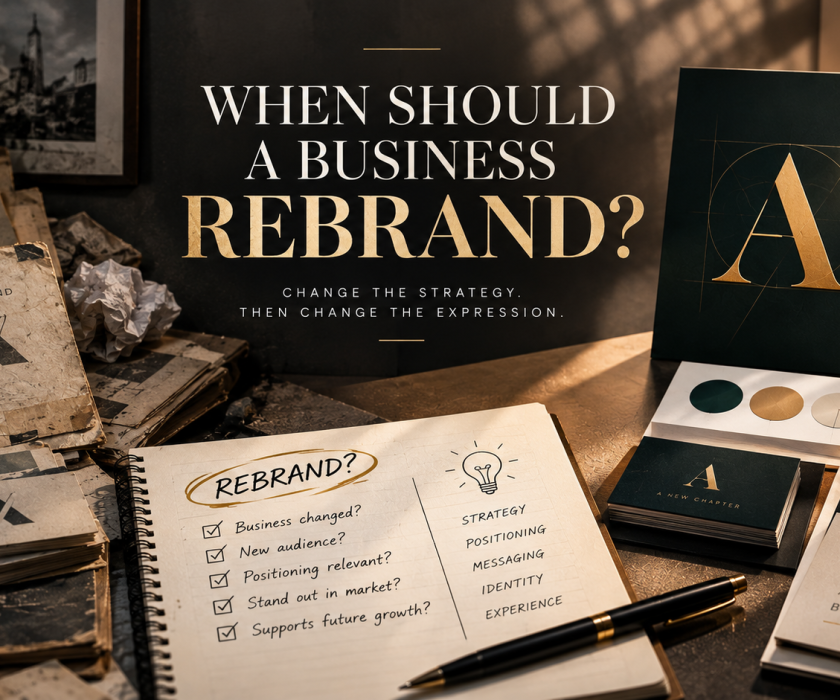
Before You Redesign Your Brand, Ask These Questions
Before commissioning a new logo or visual identity, ask:
- Do we know exactly who we’re trying to attract?
- Do we know what we want to be known for?
- Can we clearly explain why we’re different?
- Is our positioning stronger than simply saying what we sell?
- Does our current identity reflect our actual positioning?
- Is our messaging consistent with our visual identity?
- Does the customer experience deliver what the brand promises?
If you can’t answer the first four questions clearly, you may not have a design problem.
You may have a brand strategy problem.
And that is an important distinction.
Final Thought
Great branding isn’t created by choosing a logo first and finding a meaning for it later.
It starts with understanding the business, the audience, the market and the opportunity.
Then comes the strategic decision:
What should this brand mean?
Only after that comes the creative question:
How should that meaning look, sound and feel?
That is why brand strategy and brand identity are not competing disciplines.
They are two parts of the same process.
Strategy gives the brand direction.
Identity gives it expression.
Experience gives it credibility.
Consistency gives it memory.
And when all four work together, a brand becomes more than something that looks good.
It becomes something people can recognise, understand and remember.
Want to Build a Brand With More Than Just a Logo?
If your business has a strong product but an unclear position, inconsistent communication or an identity that no longer represents where you want to go, the problem may be deeper than design.
AS U WISH helps businesses clarify their brand strategy, positioning, messaging and identity—so that the design isn’t just attractive, but strategically meaningful.
Explore Brand Strategy & Consulting → Let’s Talk
Comment(01)