

BRAND STRATEGYBRANDING
When should a business rebrand?
A rebrand is one of the biggest decisions a business can make.
It can change how your company / brand looks, how it communicates, how people perceive it and, in some cases, even how the business itself is positioned in the market.
But there is one question businesses often ask too late:
Do we actually need a rebrand?
Sometimes the answer is yes.
Sometimes the business needs a brand refresh.
And sometimes the problem has nothing to do with the logo, colours or visual identity at all.
The real question isn’t whether your brand looks old.
It is whether your brand still represents the business you are today, and the business you want to become.
That is where rebranding begins.
What Is a Rebrand?
A rebrand is a strategic change to how a business defines, expresses and presents itself.
Depending on the situation, it can involve changes to:
Brand positioning
Brand strategy
Target audience
Brand promise
Brand personality
Messaging
Visual identity
Logo
Typography
Colour system
Photography and visual language
Website
Packaging
Customer experience
Brand architecture
This is important because rebranding is not simply changing a logo.
A logo change may be part of a rebrand.
But changing the logo alone does not necessarily change the brand.
A business can have a completely new logo and still have the same positioning, the same confusing messaging and the same customer perception.
That is why the first question should never be:
“Should we redesign our logo?”
It should be:
“Is our current brand still helping us achieve where the business wants to go?”
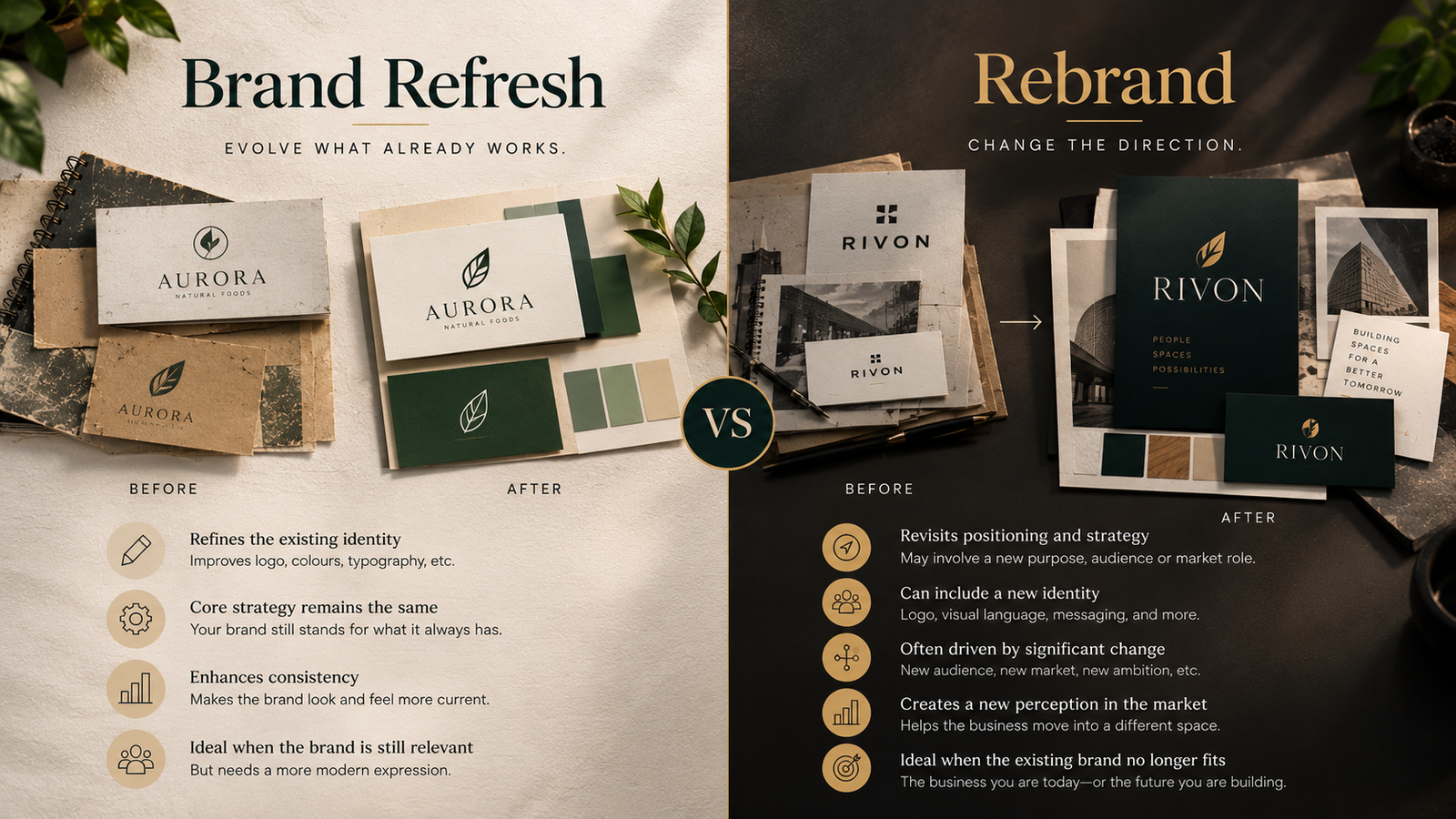
Rebrand vs Brand Refresh: They Are Not the Same
Before deciding to rebrand, it is useful to understand the difference between a rebrand and a brand refresh.
A brand refresh usually improves the existing identity without fundamentally changing what the brand stands for.
For example, a business might:
Refine its logo
Update colours
Improve typography
Modernise its website
Improve photography
Create better brand guidelines
Make communication more consistent
The core brand remains largely intact.
A rebrand is deeper.
It may involve changing the brand’s:
Positioning
Audience
Proposition
Personality
Messaging
Identity
Architecture
Market role
Think of it this way:
A refresh improves how the existing brand shows up.
A rebrand changes what the brand needs to stand for and how it shows up as a result.
Not every outdated logo needs a rebrand.
And not every serious business problem can be solved with a visual refresh.

10 Signs Your Business May Need a Rebrand
There isn’t a universal rule that says a business should rebrand after five years, ten years or twenty years.
Instead, look for signals.
Here are ten situations where a rebrand may deserve serious consideration.
1. Your Business Has Changed Significantly
Perhaps you started as a small local business.
Today, you serve customers across multiple cities.
Or perhaps you started with one product and now have an entire portfolio.
Maybe the company began as a service provider but has evolved into a technology-led business.
Or you originally targeted individuals and now primarily serve businesses.
When the business changes significantly, the brand may eventually become disconnected from reality.
Your old positioning may describe the company you were.
Your new strategy needs to describe the company you are becoming.
Ask yourself:
Does our current brand accurately represent what our business does today?
If the answer is no, that is an important rebranding signal.
2. Your Target Audience Has Changed
Brands are built for people.
If the people you want to attract have changed, your brand may need to change with them.
For example, imagine a business that originally targeted price-sensitive consumers but has gradually moved towards premium customers.
Its old communication might still focus on:
Low prices
Discounts
Accessibility
Mass appeal
But the new audience may care more about:
Expertise
Quality
Experience
Trust
Exclusivity
Service
The business has changed.
The audience has changed.
But the brand is still speaking the old language.
That creates a gap.
A rebrand can help close it.
3. Your Positioning No Longer Reflects Your Ambition
This is one of the most important reasons to consider rebranding.
Your current brand may describe what you sell.
But it may not communicate where you want to compete.
For example:
A company may have started by offering basic IT services.
Over time, it develops strong expertise in cybersecurity and enterprise technology.
But the market still sees it as a general IT vendor.
The problem isn’t necessarily the logo.
The problem is positioning.
If the business wants to move into a different strategic territory, its positioning may need to change first.
And once positioning changes, the identity and communication may need to follow.
4. Your Brand Looks Like Everyone Else
Look at your competitors.
Then look at your brand.
Do they all use:
Similar colours?
Similar typography?
Similar photography?
Similar language?
Similar websites?
Similar promises?
Similar visual styles?
If your brand could be swapped with a competitor’s brand without anyone noticing, you may have a differentiation problem.
This doesn’t necessarily mean you need a completely new logo.
It means you need to understand:
What should make this brand recognisably different?
That strategic answer should come before the creative solution.
5. Your Current Identity Feels Outdated
Sometimes the business hasn’t changed dramatically, but its visual identity has simply stopped representing the quality or personality of the company.
The logo may feel dated.
The website may feel old.
The typography may no longer work across digital platforms.
The visual system may be inconsistent.
Your competitors may communicate in a much more contemporary way.
And customers may form an impression before they ever speak to your team.
In this situation, a brand refresh may be enough.
You don’t necessarily need to throw away everything.
The question is:
Is the underlying brand still right, but the expression needs to evolve?
If yes, a refresh may be more appropriate than a full rebrand.
6. Your Brand Has Become Too Complicated
Growth can create complexity.
A company adds:
New products
New services
New sub-brands
New divisions
New markets
New audiences
Eventually, customers may struggle to understand how everything fits together.
This is often an architecture problem.
For example:
A company has five different product names, three logos and multiple websites.
Customers don’t know which brand they are dealing with.
Employees aren’t sure which identity to use.
Marketing communication becomes inconsistent.
In such cases, rebranding may involve more than a new visual identity.
It may require restructuring the brand architecture itself.
7. Your Messaging Is No Longer Clear
A strong brand should make it relatively easy for people to understand:
Who are you?
What do you do?
Who is it for?
Why should they care?
Why should they choose you?
If your website says one thing, your sales team says another and your social media communicates something completely different, the problem may not be your design.
It may be your brand strategy.
Sometimes a rebrand begins with rewriting the story.
Before redesigning the website, you may need to redefine:
Positioning
Value proposition
Brand promise
Key messages
Brand personality
Tone of voice
Only then should the visual identity translate those decisions.
8. Your Business Has Outgrown Its Original Perception
This happens frequently with growing businesses.
The company has matured.
The capabilities have improved.
The team has grown.
The clients have become larger.
The products have become better.
But the market still sees the company through the lens of its early years.
This creates a perception gap.
What the business is today ≠ what people think the business is.
A strategic rebrand can help close that gap.
But the new identity must be supported by real changes in the business.
A new logo cannot create credibility that the business hasn’t earned.
It can, however, help communicate a more accurate version of the business when the underlying reality has already evolved.
9. You Are Entering a New Market
Expansion can trigger a rebranding conversation.
Perhaps you’re moving:
From local to national
From B2C to B2B
From one industry to another
From one category into an adjacent category
From a regional market into international markets
The brand that worked in the original market may not work equally well in the new one.
The issue may involve:
Name
Language
Positioning
Brand architecture
Messaging
Before changing anything, however, understand the new market.
A rebrand should be based on the opportunity-not simply the excitement of entering somewhere new.
10. Your Brand No Longer Supports the Business You Want to Build
This is perhaps the biggest question of all.
Imagine the business you want to become over the next five or ten years.
Now look at your current brand.
Does it support that future?
Can it attract the customers you want?
Can it stretch into the categories you want to enter?
Can your positioning support higher-value offerings?
Can the identity represent the level of business you are trying to build?
If the answer is consistently no, it may be time to reconsider the brand at a strategic level.
A Rebrand Should Start With the Business, Not the Logo
One of the biggest mistakes businesses make is treating rebranding as a design project.
The conversation starts with:
“We need a new logo.”
Then someone creates moodboards.
Then colours.
Then typography.
Then logo options.
Then everyone debates which one they like.
But there is a problem.
Nobody has answered the strategic question:
What is the new brand supposed to mean?
Without that answer, design becomes subjective.
One person likes blue.
Another likes black.
Someone wants minimal.
Someone wants premium.
Someone wants something “modern.”
Eventually, the business chooses the design everyone can agree on.
But agreement is not the same as strategy.
So What Should Come Before a Rebrand?
A strong rebranding process should begin with diagnosis.
Before changing the identity, understand the current brand.
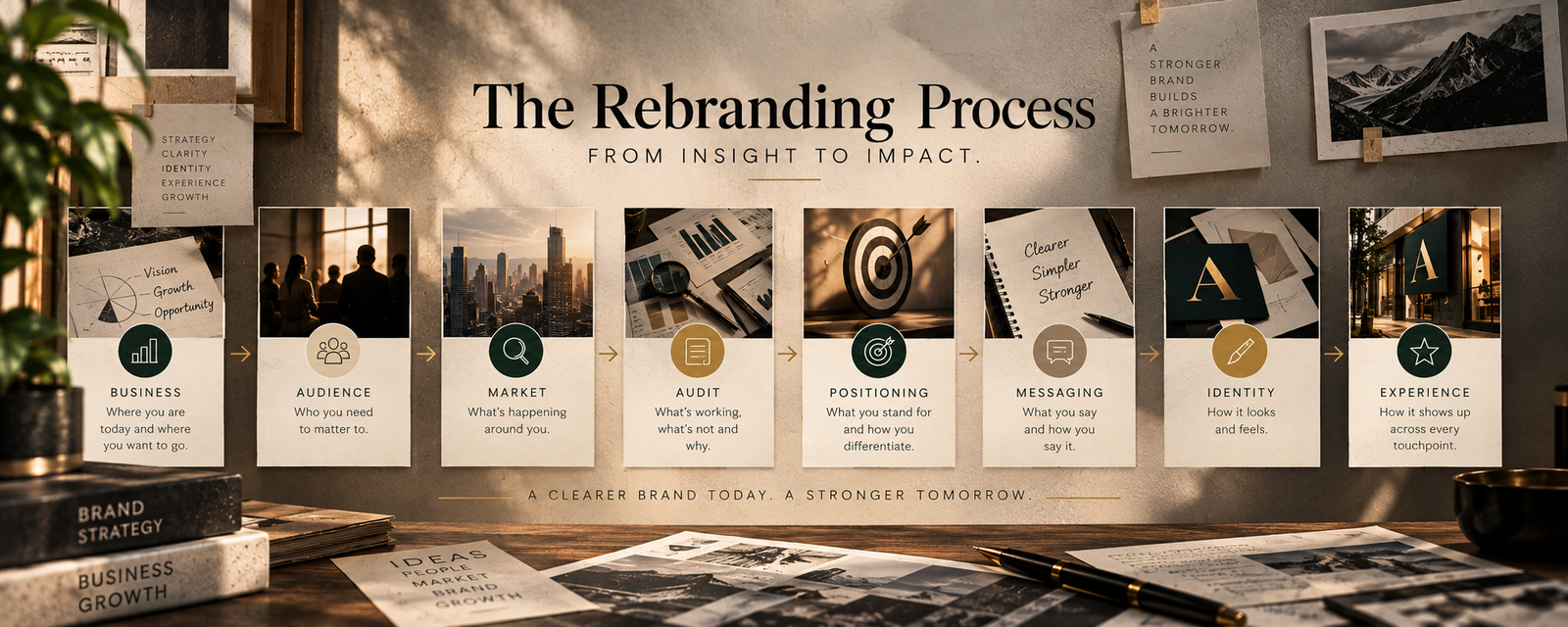
A useful process might look like this:
1. Business Understanding
Where is the business today?
Where does it want to go?
What has changed?
What needs to change?
2. Brand Audit
What is currently working?
What isn’t?
How is the brand perceived?
Where are the inconsistencies?
3. Audience Understanding
Who are the most important audiences?
What do they need?
What do they believe?
What influences their choices?
4. Market & Competitor Analysis
What does the category look like?
What territories are already crowded?
Where are competitors positioned?
What opportunities exist?
5. Positioning
What should the brand stand for?
Who should it matter to?
What should it be known for?
What makes it meaningfully different?
6. Brand Proposition & Messaging
What should the brand promise?
What should it say?
How should it communicate?
7. Brand Personality
How should the brand behave?
What should it feel like?
What should it sound like?
8. Brand Identity
Only now should the visual identity be developed.
Logo.
Typography.
Colour.
Photography.
Graphic language.
Design system.
9. Brand Experience
Finally, the new brand needs to appear consistently across:
Website
Social media
Packaging
Advertising
Sales material
Physical spaces
Customer communication
Internal communication
This is how a rebrand becomes more than a new logo.
What Should You Keep During a Rebrand?
Rebranding doesn’t mean destroying everything that came before.
Some elements may have accumulated valuable recognition over time.
That could include:
Brand name
Logo equity
Colours
Taglines
Product names
Packaging
Customer associations
Brand stories
Existing reputation
The question is not:
“What can we change?”
The better question is:
“What should change, and what should we protect?”
A good rebrand preserves valuable equity while addressing what no longer works.
When You Should NOT Rebrand
This is just as important as knowing when you should.
You probably shouldn’t rebrand simply because:
Your competitor launched a new logo
Their brand strategy is not necessarily your strategy.
You personally got bored of the logo
Brand familiarity can sometimes make an identity feel less exciting to the people who work with it every day, even when customers still recognise it.
A new design trend is popular
Trends change.
A brand needs a system that can work beyond the current design cycle.
Your sales are declining
A rebrand may help if the underlying issue involves positioning, perception or relevance.
But if the real problem is product quality, pricing, distribution, customer service or sales execution, changing the logo won’t solve it.
Your new marketing agency wants to redesign everything
A new agency should first understand your business and brand.
A redesign should be the result of a strategic diagnosis—not the starting assumption.
Rebranding Is Not a Cure for Every Business Problem
This distinction matters.
Suppose your business is struggling because:
Your product isn’t competitive
Your pricing is wrong
Customers are unhappy
Distribution is weak
Sales execution is poor
Your service quality has declined
Changing the brand identity won’t automatically fix those problems.
Branding can influence perception.
It can create clarity.
It can improve differentiation.
It can help a business communicate its value more effectively.
But the brand cannot substitute for a strong business.
A rebrand should amplify a better business, not disguise a broken one.
How Do You Know If You Need a Rebrand or a Refresh?
Try answering these questions:
Question 1
Has our business strategy changed significantly?
Question 2
Has our target audience changed?
Question 3
Has our positioning changed?
Question 4
Has our market or category changed?
Question 5
Does our current identity still represent our ambition?
Question 6
Is our messaging clear and consistent?
Question 7
Are customers confusing us with competitors?
Question 8
Have we accumulated too many brands, products or identities?
Question 9
Does our current brand create the perception we actually want?
Question 10
Can our current brand support where we want the business to go?
If most of the problems are strategic, you may be looking at a rebrand.
If the strategy is still right but the expression feels dated or inconsistent, a brand refresh may be more appropriate.
And if the brand is fundamentally right but communication is inconsistent, you may simply need stronger brand guidelines and execution.
The Real Question Isn't "Do We Need a New Logo?"
It is:
“Has the relationship between our business, our audience and our brand changed?”
If the answer is yes, investigate why.
Perhaps the business has evolved.
Perhaps the audience has changed.
Perhaps the market has moved.
Perhaps your positioning is no longer relevant.
Perhaps your identity is no longer expressing what the business stands for.
Or perhaps the problem isn’t the brand at all.
That diagnosis is what makes a rebrand strategic.
A Simple Rebranding Framework
You can think about the process as:
Business Change → Brand Audit → Audience & Market Understanding → Positioning → Differentiation → Messaging → Brand Personality → Visual Identity → Brand Experience → Perception
The important part is the sequence.
You don’t redesign the identity first and then search for a reason.
You understand the business first.
Then define what the brand needs to mean.
Then create the identity that makes that meaning visible.
A Rebrand Should Create More Clarity, Not More Noise
A successful rebrand should make things clearer.
Your team should understand what the brand stands for.
Your customers should understand what you offer.
Your marketing should have a clearer direction.
Your sales team should have stronger language.
Your visual identity should feel more consistent.
Your brand should have a clearer position in the market.
If a rebrand creates a beautiful identity but leaves everyone confused about what the company actually stands for, something important has been missed.
The goal isn’t simply to look different.
The goal is to become more relevant, more distinctive and more aligned with the business you are building.
Rebranding Is a Strategic Decision
There is no perfect age for a rebrand.
A five-year-old company may need one.
A fifty-year-old company may not.
The decision should come from change, not from a calendar.
Ask:
Has the business changed?
Has the audience changed?
Has the market changed?
Has the ambition changed?
Has the perception changed?
Has the brand stopped communicating the value the business actually creates?
If the answer is yes, it may be time to look at the brand again.
And when you do, don’t begin with the logo.
Begin with the thinking.
Because the strongest rebrands don’t simply make businesses look different.
They make the brand more aligned with where the business is going.
Final Thought
A rebrand is not about escaping your past.
It is about deciding what deserves to continue—and what needs to evolve.
Keep the equity that matters.
Change what no longer works.
Clarify what the business stands for.
Define where the brand should compete.
Understand who you need to matter to.
Then create an identity that expresses that direction.
Strategy should lead the rebrand. Design should make the strategy visible. Experience should make it believable.
That is how a rebrand becomes more than a new logo.
It becomes a new chapter for the brand.
Is Your Business Ready for a Rebrand?
If your business has evolved but your brand hasn’t evolved with it, the problem may be deeper than your visual identity.
AS U WISH helps businesses evaluate their current brand, clarify positioning and develop the strategic and creative direction needed for a rebrand or brand refresh.
Explore Brand Strategy & Consulting
Talk to AS U WISH about your brand
Abhijeet Singh
Abhijeet Singh is the Founder of AS U WISH and a Brand Consultant and Idea Strategist working across branding, advertising, design and communication. His approach combines strategic thinking with creative direction to help businesses build clearer, more distinctive and meaningful brands.