
BRAND STRATEGYBRANDING
Social Media Is Not a Brand Strategy
Your business has an Instagram account. You post regularly, share reels, publish festival creatives, run occasional promotions and perhaps even have someone managing your social media.
But here is a question worth asking:
If you stopped posting for a month, would people still know what your brand stands for?
Would they understand what makes your business different? Would they remember why they should choose you? Would they associate your brand with a particular idea, experience or promise?
If the answer is unclear, you may have a social media presence without a clear brand strategy.
This is a distinction many businesses overlook.
Social media has become an important part of how brands communicate. It helps businesses reach audiences, share information, build relationships and generate opportunities. But having an active social media account does not automatically mean a brand has a strategy.
Because social media is where you communicate. Brand strategy determines what you need to communicate, why it matters and what you want people to remember.
The confusion between being active and building a brand
For many businesses, marketing begins with a content calendar.
How many posts should we publish this month? How many reels do we need? Which festivals are coming up? What are competitors posting? Which trend should we follow?
These questions are not necessarily wrong. Content planning and consistency matter. But they address the execution of communication, not the strategic direction behind it.
A business can publish every day and still struggle to explain what makes it different.
It can have thousands of followers without attracting the right customers. It can receive likes and comments without generating meaningful enquiries. It can look active online while its brand identity remains unclear.
The problem is not social media itself. The problem is expecting a communication channel to solve questions that should have been addressed before choosing that channel.
Posting more frequently cannot automatically fix unclear positioning. A better-designed carousel cannot replace a compelling value proposition. A viral reel cannot guarantee long-term brand recognition.
Visibility and brand building are related, but they are not the same thing.


What is a brand strategy?
A brand strategy is the thinking that gives a brand direction.
It establishes what the business stands for, whom it wants to serve, how it wants to be perceived and what makes it meaningfully different from alternatives.
It helps answer fundamental questions:
- What does the brand stand for?
- Who is the audience it wants to reach?
- What problem does it solve?
- Why should people choose it?
- What should people associate with it?
- How should it communicate across different touchpoints?
These answers influence much more than social media.
They shape the brand’s identity, messaging, campaigns, customer experience, website communication, packaging, advertising and long-term marketing decisions.
Social media becomes one expression of that strategy.
Without a strategic foundation, businesses often end up communicating different things at different times, depending on what seems popular or urgent.
A clear brand strategy creates consistency in direction, even when the formats and platforms change.
Social media is a channel, not the strategy
Think of social media as one of the places where people encounter your brand.
Your audience may also discover you through a Google search, a recommendation, an advertisement, a website, a physical store, a product package, an event or a conversation.
Each of these is a touchpoint.
Your brand does not exist only on Instagram. It exists in the overall impression people develop through their interactions with your business.
That is why a brand needs a consistent foundation across channels.
Imagine a business that presents itself as premium on social media but has an outdated website, inconsistent communication and an unstructured customer experience.
The social media page may look impressive, but the overall brand experience tells a different story.
A brand strategy helps connect these experiences. It provides a common direction for how the business looks, speaks and behaves.
Social media can communicate that direction, but it cannot create the entire foundation on its own.
Five things social media cannot replace
1. Brand positioning
Positioning defines the place a brand wants to occupy in the minds of its intended audience.
It helps establish why the brand should be considered and what distinguishes it from competitors.
Without positioning, social media communication can become generic.
A healthcare business may repeatedly post about care and trust. A clothing brand may talk about quality and style. A restaurant may promote taste and experience.
These are familiar messages. The question is what makes each brand’s promise distinctive and credible.
Positioning gives content a clearer point of view. It helps the brand move beyond saying what every competitor says.
This is why we believe positioning should be established before deciding how the brand communicates visually or verbally.
Read more: Brand Positioning: Why Your Business Needs Positioning Before a Logo
2. Brand identity
A social media page may have attractive graphics, but that does not automatically mean the business has a complete brand identity.
A brand identity includes the visual and verbal elements that help people recognise and understand a brand.
It can include the logo, typography, colours, imagery, graphic language, tone of voice and messaging principles.
These elements should work together across the website, advertisements, packaging, presentations, social media and other brand touchpoints.
When a business changes its visual style with every new trend, its communication may become inconsistent.
A clear identity system makes it easier to create different types of content while maintaining a recognisable brand presence.
Social media can display a brand identity. It should not be the only place where that identity is considered.
3. A clear value proposition
Why should someone choose your business?
What do you offer that is relevant to your audience? What problem do you solve? What makes your offering valuable?
These questions form the foundation of a value proposition.
Without a clear answer, social media posts often rely on broad claims such as:
- Best quality.
- Customer satisfaction.
- Affordable prices.
- Trusted service.
- Innovative solutions.
There is nothing inherently wrong with these statements. The problem is that almost any business can use them.
A stronger value proposition explains what the brand actually offers and why that matters to the customer.
Once that is clear, content becomes more purposeful. Instead of repeatedly claiming to be the best, the brand can demonstrate its value through useful information, examples, experiences and proof.
4. A consistent brand experience
A brand is not built only through what it publishes. It is also shaped by what people experience.
Consider the journey of a potential customer.
They discover your business on Instagram, visit your website, contact your team, receive a proposal and eventually purchase your product or service.
Every interaction contributes to their impression of the brand.
If the communication is professional but the response is delayed, the experience becomes inconsistent. If the advertisement promises simplicity but the buying process is confusing, the brand’s promise loses credibility.
Social media may create the first impression, but the rest of the business must support it.
Brand strategy helps connect communication with the experience the business intends to deliver.
5. Long-term brand direction
Social media platforms, formats and trends change constantly.
A format that performs well today may lose popularity tomorrow. Algorithms evolve. Audience behaviour shifts. New platforms emerge.
A business that builds its entire marketing approach around one platform risks becoming dependent on something it does not control.
A brand strategy provides a longer-term direction that can survive these changes.
The platform may change, the format may change and the campaign may change. But the brand’s purpose, positioning and fundamental promise should remain coherent unless there is a deliberate strategic reason to evolve them.
That is the difference between following every new trend and building a brand with a clear direction.

What happens when businesses confuse social media with brand strategy?
The consequences are often visible in the way businesses communicate.
Content without a clear message
Every month brings new topics, but there is no consistent idea connecting them. One week the brand talks about quality, the next it follows a trend, and the week after it publishes generic motivational content.
The page remains active, but the brand’s identity becomes difficult to understand.
Competing only on visibility
Businesses begin comparing follower counts, views and engagement rates without asking whether they are reaching the right audience.
Attention becomes the goal instead of a means to achieve a meaningful business objective.
Constantly changing the creative direction
The brand adopts a new design style, tone or content format whenever something else appears popular.
Over time, the audience sees a collection of disconnected executions rather than one recognisable brand.
Depending on discounts and promotions
When there is no clear reason for customers to choose the brand, promotional offers can become the easiest way to attract attention.
Discounts may support a sales objective, but a brand that communicates only through offers risks making price its primary point of differentiation.
Expecting immediate business results
Businesses sometimes expect social media posts to generate enquiries and sales without considering the wider customer journey.
Content can create awareness and interest, but conversion may also depend on the offer, credibility, website experience, pricing, sales process and customer service.
Social media is part of the marketing system. It is not the entire system.
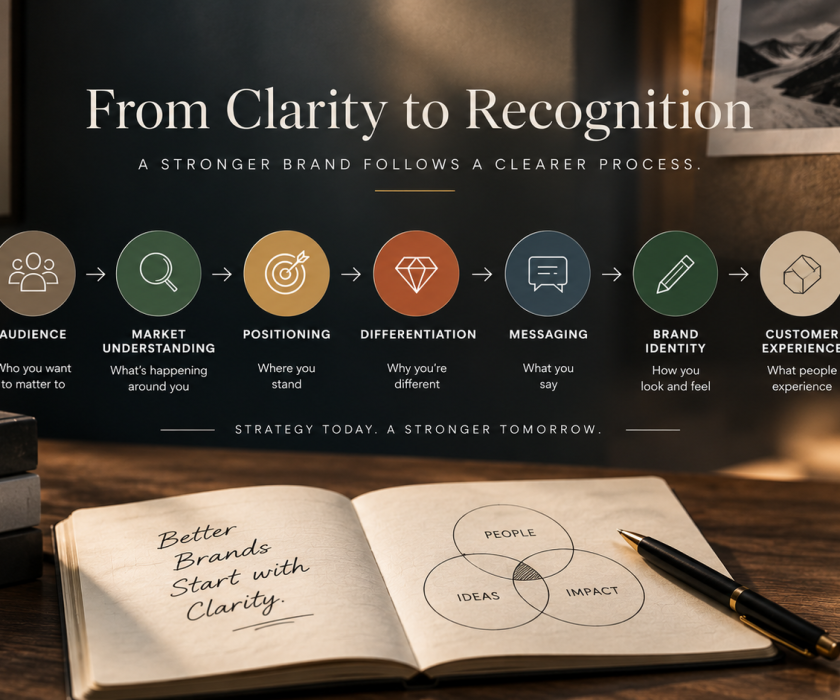
What should come before social media planning?
Before deciding what to post, a business should establish the strategic foundations that guide its communication.
Here is a practical sequence.
Step 1: Understand the business
Start by understanding the business itself.
What does it offer? What are its strengths? What are its ambitions? What problems does it solve? What does it want to become known for?
Content should reflect the business’s actual value, not simply what is easy to publish.
Step 2: Understand the audience
Identify the people the business wants to reach.
Go beyond age, gender and location. Understand their needs, motivations, concerns, preferences and decision-making behaviour.
The better the understanding, the more relevant the communication can become.
Step 3: Define the positioning
Establish how the brand should be differentiated and what it should represent in the market.
This creates a reference point for messaging, visual identity, campaigns and content.
Step 4: Develop the brand message
Decide what the brand needs to communicate consistently.
Clarify the value proposition, key messages, personality and tone of voice.
This helps ensure that different posts and campaigns reinforce a common understanding of the brand.
Step 5: Choose the right communication channels
Now evaluate where the intended audience spends time and how the business can reach them effectively.
Social media may be important. So may search, a website, email, advertising, events, partnerships or offline communication.
The right mix depends on the audience, objective, resources and nature of the business.
Step 6: Build the content strategy
Once the direction is clear, identify the themes, ideas, formats and content roles that support it.
Decide what the brand should educate people about, what stories it should tell, what conversations it should participate in and what actions it wants to encourage.
Content planning becomes much easier when it has a strategic foundation.
Step 7: Measure what matters
Evaluate social media based on its contribution to the business objective.
Reach and engagement may help assess visibility and interaction. Website visits, qualified enquiries and conversions may provide evidence of business outcomes.
Do not treat every metric as equally important. The right measure depends on what the activity was designed to achieve.
Social media still matters. But it needs a bigger picture.
None of this means social media is unimportant.
For many businesses, it is an effective way to build awareness, share expertise, communicate with customers, demonstrate products, distribute campaigns and create opportunities.
But its effectiveness improves when it has a clear role within a broader brand and marketing strategy.
A well-positioned brand can use social media to reinforce its point of view. A strong identity can make its content recognisable. A clear value proposition can make its communication more relevant. A consistent customer experience can help turn attention into trust.
The platform provides the opportunity to communicate.
The strategy provides the direction.
The real question is not how often you post
Many businesses begin their marketing conversations with questions about frequency.
How many posts should we publish? How many reels should we make? How much should we spend on social media?
These questions matter, but they should not be the first questions.
Start with something more fundamental:
What should people know about our brand?
What should they remember?
Why should they choose us?
What do we want our communication to achieve?
Once these questions have clear answers, social media planning becomes more purposeful. Content has a direction. Creative work has a reason. Campaigns become more connected to business objectives.
At AS U WISH, we believe that brands need clarity before creativity. We bring strategy, identity, creative campaigns and content thinking together to help businesses communicate with meaning.
Because a brand is not built by the number of posts it publishes.
It is built by what people understand, experience and remember about it.
Looking beyond social media management?
AS U WISH helps businesses build stronger brand foundations through brand strategy, identity, creative campaigns and content & digital communication.
Explore our services or get in touch to discuss the strategic direction of your brand.